
EVENTS
KSIDC Korean Language & Culture Classes: Fall 2026 (Registration now OPEN!)
- Post DateAug 21, 2026
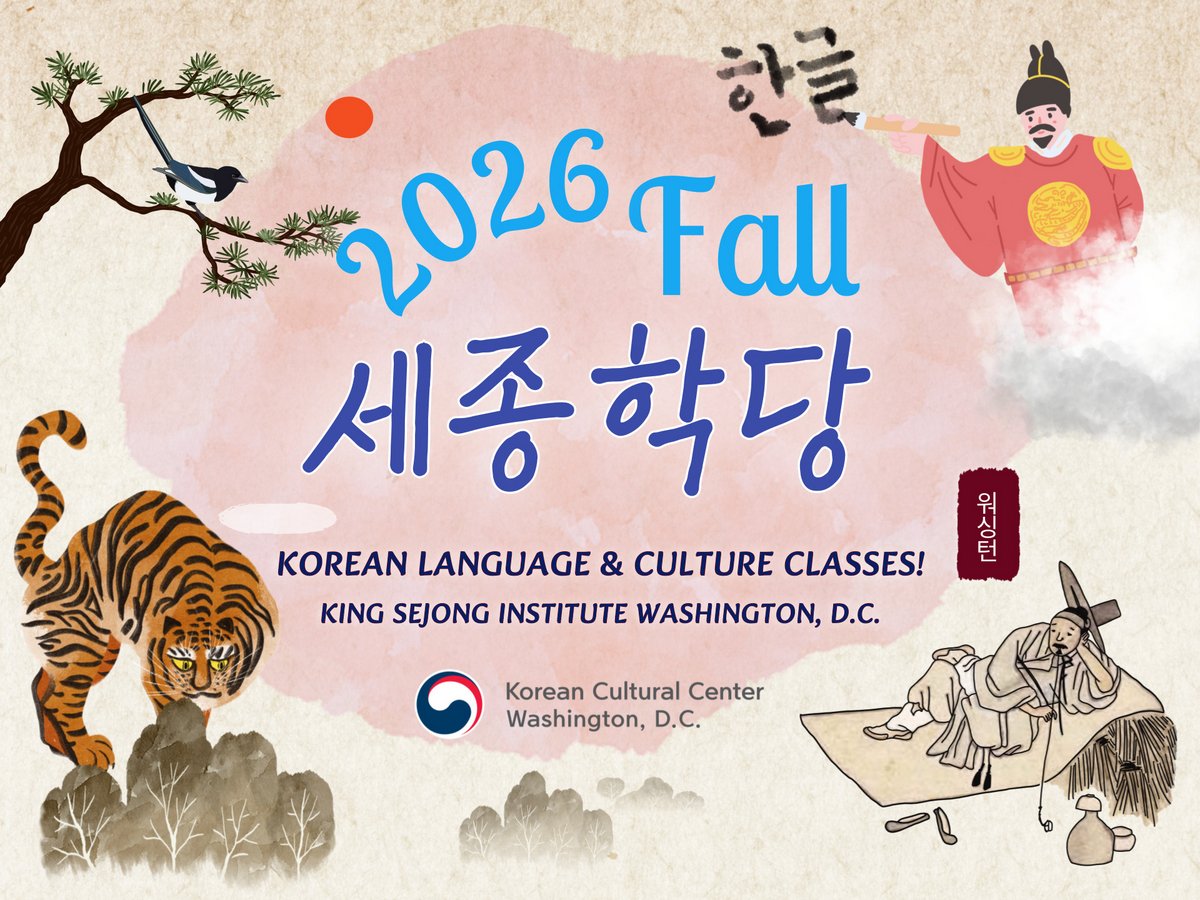
Registration is now OPEN for Fall 2026 classes at the King Sejong Institute Washington, D.C.!
Focused on practical language skills and cultural context, the King Sejong Institute Washington, D.C. (KSIDC) offers a range of classes that build skills in speaking, reading, listening, and writing Korean. All classes are limited in size (10-14 learners on average) and led by native Korean-speaking instructors with teaching experience at U.S. universities or professional institutions. Classes primarily teach language skills, while also introducing students to the traditional, modern, and social culture of Korea. Most KSIDC courses are currently offered remotely online with no location restrictions, typically in addition to some in-person course options in Washington, D.C.
The KSIDC is a DC-based 501(c)3 nonprofit organization which operates Korean language classes and educational programs in partnership with the Korean Cultural Center. Registration for all KSIDC classes is open to the public, and all those who wish to improve their Korean are welcome! For more details, see our nondiscrimination policy below.
Nondiscrimination Policy
The King Sejong Institute Washington, D.C. admits students of any race, color, national and ethnic origin to all the rights, privileges, programs, and activities generally accorded or made available to its students. It does not discriminate on the basis of race, color, national and ethnic origin in administration of its educational policies, admission and registration policies, support related to registration costs, and other school-administered programs. All are welcome!


Follow the KSIDC on Facebook for early updates and more!
2026 Schedule
Spring: early February – May
Summer: early June – August
Fall: September – December
Exact start and end dates for each class vary. A detailed schedule will be added to this website and sent to our mailing list a few weeks before each session of classes.
Overview
Schedule
The Fall 2026 session offers a majority of courses that meet online/remote with regular video meetings via Zoom or other platforms, generally during weekday evenings with some Saturday morning and afternoon options, as well as in-person courses that meet at the Korean Cultural Center Washington, D.C. In-person and online courses cover the same content and meet for the same amount of time.
All courses meet primarily once per week for a total of 24 class hours/12 meetings and finish by mid-December at the latest (earlier without cancellations). All online courses include the option to review full class recordings for a period of time after each meeting; in-person class meetings do not include recordings, but do include other perks: light Korean refreshments during every meeting, cultural exposure and special invites from the KCCDC, and a final class catered Korean dinner party. In the future, the majority of courses will remain online/remote as we expand in-person options.
Fees
Registration fees are as follows, per entire course (comprising 24 class hours / 12 meetings):
Registration Fees | Online | In-person/Hybrid |
New Students: | $240 | $250 |
Returning Students: | $220 | $230 |
The registration fee for new registrants is $240 (online) or $250 (in-person/hybrid) per complete course (comprising 24 class hours/12 meetings). Returning registrants receive a discounted rate of $220 (online) or $230 (in-person/hybrid). Textbooks are required for all courses, and can be purchased independently or through the KSIDC for $45 with registration (excluding those for Advanced and certain special topic courses; details below). All courses are contingent upon a minimum enrollment, and tuition is fully refundable until the day after the first class meeting. Fees may change in the future, as we adjust our online/offline pricing.
Textbooks
The KSIDC offers textbooks for all regular sequence courses (Beginner through Intermediate) for $45 per complete set (comprising the Sogang student book, workbook, and grammar booklet together). However, textbooks purchased from the KSIDC MUST be picked up locally in Washington, D.C. on one of the designated pickup dates (we cannot ship individual textbooks). Non-local students are thus encouraged to purchase their books independently. View a complete reference list of textbooks with links for this session here.
In-Person Courses
We are pleased to maintain some in-person courses that meet at the Korean Cultural Center Washington, D.C., including core Beginner 1 and Beginner 2 levels. In-person classes are generally a similar size to online (12-14). In-person class meetings are not recorded for review like online meetings, but instructors are generally available before in-person class to help anyone catch up. On-site parking is not provided, but local street parking is generally available in the mostly residential nearby neighborhoods. Textbooks purchased with registration can be picked up in-person the first day. Those participating in in-person classes are also required to sign a general waiver/release form, which will be provided by email upon registation. We hope to offer more robust in-person options in future sessions!
Please note: in-person courses may schedule 1-2 meetings on a Thursday this session, if needed to finish on time, although we will strive to minimize this possibility.
Eligibility & Other Terms
KSIDC classes are open to anyone, but registrants must be at least age 15 at the start (a parental consent/waiver/media release form is also required for those under age 18). Classes are generally taught in English, except for some advanced and special topic options. Parents of minors should be aware that most registrants are adults and most classes involve either virtual breakout rooms or pair work, and thus parents are required to supervise and take primary responsibility for participating minors throughout the course, in-person and online. We hope to offer youth classes in the future, so please stay tuned and join our mailing list for updates. See our nondiscrimination policy for details.
Perks
Learners with 75% attendance or better receive a certificate of completion upon completion of the course. All online courses include the option to review class recordings for a period of time after each meeting. Students can also arrange to meet before or after class with their instructor during virtual or in-person office hours, as available. In-person classes do not include recordings but instructors are usually available before class and in-person courses also include light Korean refreshments during the breaktime of every meeting as well as a final class catered Korean dinner party and food-making workshop. Although refreshments and the dinner are not possible remotely, online courses instead feature reduced average class size to help facilitate online learning and greater individualized attention, in addition to more schedule and viewing options.
Registration
To register for any course listed here, scroll down to see the registration steps at the bottom of this page.
Schedule of Classes
Scroll down for complete class description, textbook, and placement information below. Special or irregular times/dates are underlined. If a class is full, sometimes from the start due to continuing students, join the waitlist! Depending on demand, additional groups may be added. Those on the waitlist will be notified first of any new options. All lettered "groups" cover the same content within each level, but may occur on different schedules or with different instructors.
Regular Sequence Courses
Beginner 1
Beginner 1, Group A (Mondays) 4:45-6:45pm EDT
Instructor: Eunhae Ro, starting Sept. 21 IN-PERSON
This group may also meet 1-2 times on Thursdays, if needed.
Tentatively full! Join the waitlist.
Beginner 1, Group B (Mondays) 6:00-8:00pm EDT.
Instructor: Hyewon Kang, starting Sept. 14 ONLINE
Tentatively full! Join the waitlist.
Beginner 1, Group C (Tuesdays) 6:00-8:00pm EDT.
Instructor: Juyoung Park, starting Sept. 15 ONLINE
Tentatively full! Join the waitlist.
Beginner 1, Group D (Thursdays) 6:00-8:00pm EDT.
Instructor: Hannah Chong, starting Sept. 17 ONLINE
Tentatively full! Join the waitlist.
Beginner 1, Group E (Saturdays) 10:00am-12:00pm EDT.
Instructor: Jiyoung Yim, starting Sept. 12 ONLINE
Beginner 2
Beginner 2, Group A (Monday) 4:45-6:45pm EDT.
Instructor: Yun Jang, starting Sept. 21 IN-PERSON
This group may also meet 1-2 times on Thursdays, if needed.
Tentatively full! Join the waitlist.
Beginner 2, Group B (Monday) 6:00-8:00pm EDT.
Instructor: Hannah Chong, starting Sept. 14 ONLINE
Beginner 2, Group C (Tuesdays) 6:00-8:00pm EDT.
Instructor: Jin Choi, starting Sept. 15 ONLINE
Tentatively full! Join the waitlist.
Beginner 2, Group D (Thursdays) 6:00-8:00pm EDT.
Instructor: Eunjin "Hannah" Kim, starting Sept. 17 ONLINE
Tentatively full! Join the waitlist.
Beginner 2, Group E (Saturdays) 1:00-3:00pm EDT.
Instructor: Hannah Chong, starting Sept. 19 ONLINE
Beginner 3
Beginner 3, Group A (Tuesdays) 6:00-8:00pm EDT.
Instructor: Jiyoung Yim, starting Sept. 15 ONLINE
Tentatively full! Join the waitlist.
Beginner 3, Group B (Wednesdays) 6:00-8:00pm EDT.
Instructor: Heecho Kim, starting Sept. 16 ONLINE
Tentatively full! Join the waitlist.
Beginner 3, Group C (Thursdays) 6:00-8:00pm EDT.
Instructor: Keum Sook Yang, starting Sept. 17 ONLINE
Beginner 3, Group D (Saturdays) 1:00-3:00pm EDT.
Instructor: Heecho Kim, starting Sept. 19 ONLINE
Intermediate 1
Intermediate 1, Group A (Tuesdays) 6:00-8:00pm EDT.
Instructor: Yun Jang, starting Sept. 15 ONLINE
Tentatively full! Join the waitlist.
Intermediate 1, Group B (Wednesdays) 6:00-8:00pm EDT.
Instructor: Jiyoung Yim, starting Sept. 16 ONLINE
Intermediate 1, Group C (Saturdays) 10:00am-12:00pm EDT.
Instructor: Heecho Kim, starting Sept. 19 ONLINE
See also Intermediate 1: Extended + Review below!
Intermediate 2
Intermediate 2, Group A (Tuesdays) 6:00-8:00pm EDT.
Instructor: Eunjin "Hannah" Kim, starting Sept. 15 ONLINE
Tentatively full! Join the waitlist.
Intermediate 2, Group B (Saturdays) 10:00am-12:00pm.
Instructor: Hannah Chong, starting Sept. 19 ONLINE
Tentatively full! Join the waitlist.
See also Intermediate 1: Extended + Review below!
Intermediate 3
Intermediate 3, Group A (Wednesdays) 6:00-8:00pm EDT.
Instructor: Hei Sook Yoo, starting Sept. 16 ONLINE
Special Topic & Advanced
Intermediate 1 Extended + Review (Wednesdays) 6:00-8:00pm EDT.
Instructor: Eunjin "Hannah" Kim, starting Sept. 16 ONLINE
This course primarily reviews and completes the content covered in Intermediate 1, to help reinforce learning at this level.
Tentatively full! Join the waitlist.
Advanced: Exploring Korean Communication and Culture through Zodiac Proverbs
(Mondays) 6:00-8:00pm EDT. Instructor: Hei Sook Yoo, starting Sept. 14 (high intermediate/advanced).
Descrtiption: This high intermediate/advanced course explores how Korean proverbs (속담, sok-dam) are not merely fixed expressions for everyday life, but profound cultural reflections that reveal how people understand human behavior, values, and social relationships. This advanced course explores common Korean proverbs and idioms through the particular symbolic lens of the twelve zodiac animals (십이지, sip-i-ji). For example, one might comprehend the saying “even in a mouse hole, the sun shines” (쥐구멍에도 볕 들 날 있다), but what might it convey emotionally, imply for the future, or reveal about the speakers’ relationship? Learners will analyze how animal imagery can function as a metaphor for universal aspects of human life, conveying wisdom, caution, humor, or moral judgment as needed.
Prerequisite: Completion of KSIDC Intermediate 3, any advanced course, or equivalent. See the course overview and proficiency details/self-test reading samples here, or email adam@ksiwashingtondc.org to receive a detailed syllabus or to contact the instructor.
Click here to join the general WAITLIST for any class that is tentatively full!
Depending on demand, new groups may be added.
Registration / More Information
The King Sejong Institute Washington, D.C. admits students of any race, color, national and ethnic origin to all the rights, privileges, programs, and activities generally accorded or made available to its students. It does not discriminate on the basis of race, color, national and ethnic origin in administration of its educational policies, admission and registration policies, support related to registration costs, and other school-administered programs. All are welcome!
All registration is first come, first served by email request, until maximum enrollment. Please first check the class status above (updated weekdays). To submit a registration request, indicate the specific class/group for which you would like to register in an email to Adam Wojciechowicz at adam@ksiwashingtondc.org. Requests will receive a reply with details on registration / payment forms within 1-3 days, in the case that the class is still open—thank you for your patience! If a class is full, we strongly recommend joining the waitlist, as additional sections might be added based on demand, or space may open up. There is no location restriction for online courses (but all class times are EDT).
PLEASE NOTE: Registration requests are taken in the order received until a class is full, at which point a waitlist option will be added to the website and existing registration requests will be confirmed. Classes may become full before we are able to update the website. Joining the waitlist is a good idea, as enrollment often shifts before the start of class and space opens up. Some classes fill up very quickly, especially with smaller online groups, so we appreciate your patience and understanding. For any questions, contact Adam at adam@ksiwashingtondc.org or (202) 587-6168 (email is best).
Nondiscrimination Policy
Course Descriptions, Textbooks, & Placement Reading Samples
For reference links to specific textbooks for this session, see the detailed guide linked above.
Beginner 1
Textbook: NEW Sogang Korean 1A Student Book AND Workbook (2nd Edition)
Description: This class is designed for those who have no previous experience learning Korean. Students will be introduced to the Korean alphabet Hangeul, basic sentence structures, simple vocabulary, and conversation. By the end of the semester, students will be able to read and write Hangeul, introduce themselves, exchange greetings, count numbers, order food at a restaurant, and carry out basic daily conversation. Cultural aspects will also be included in the course content, so that students may grow in their understanding of Korean culture and share their cultural experiences. Students will be encouraged to speak Korean in class through different communicative activities often carried out in pairs or groups. There will be weekly assignments and quizzes to review what was covered in class. Students in this class will be able to continue to Beginner 2 during the next session.
Beginner 2
Textbook: NEW Sogang Korean 1A Student Book AND Workbook (2nd Edition)
Description: Beginner 2 is a continuation from Beginner 1 and is appropriate for beginner learners who have some prior experience learning Korean. Students are expected to be able to read and write the Korean alphabet, Hangul, and understand basic Korean dialogue, such as exchanging greetings, ordering food, and asking for information. This course will focus on developing essential conversational skills needed for daily communication in Korean, such as making an appointment, talking about daily activities and past events, and asking for/giving directions. In addition, students will learn to use the formal/deferential speech style and make the 5 Wh- questions in Korean. Cultural aspects will also be included in the course content, so that students may understand social and historical distinctiveness of Korean culture. Students will be encouraged to speak Korean in class through different communicative activities carried out in pairs or groups. There will be weekly assignments and quizzes to review materials covered in class. Students in this class will be able to continue to Beginner 3 in the next session.
New students registering for Beginner 2 should understand most of the following sample dialogue:
앤디: 미나 씨, 오늘 일해요?
미나: 아니요.
앤디: 그럼 뭐 해요?
미나: 친구 집에 가요.
앤디: 몇 시에 친구 집에 가요?
미나: 여덟 시에 친구 집에 가요.
Beginner 3
Textbook: NEW Sogang Korean 1B Student Book AND Workbook (2nd Edition)
Description: Beginner 3 builds on the basic foundation established in Beginner 1 and 2. This class is appropriate for those who have completed both Beginner 1 and 2 at the King Sejong Institute or those who have taken an elementary Korean course in college. Students who register for this class need to have basic knowledge of sentence structures, the present and past tense verb conjugation, informal and formal speech styles, and numeral systems in Korean. In this class, students will be introduced to diverse settings of daily conversation and specific tasks to be carried out in Korean. By the end of the semester, students will be able to talk about future plans and previous experiences, describe and compare varied things, make suggestions, ask for a favor, give reasons, prepare for a job interview, and use honorifics. Authentic materials in Korean, including drama clips, news, commercials, and music will be used to understand the usage of varied expressions and to broaden cultural understanding. There will be regular assignments and quizzes to review the materials covered in class.
New students registering for Beginner 3 should understand most of the following sample dialogue:
앤디: 미나 씨, 주말에 뭐 했어요?
미나: 공원에 갔어요.
앤디: 공원에 운동하러 갔어요?
미나: 아니요, 친구를 만나러 갔어요.
앤디: 그런데 근처에 공원이 있어요?
미나: 네, 집 앞에 있어요.
Intermediate 1
Textbook: NEW Sogang Korean 2A Student Book AND Workbook (2nd Edition)
Description: Intermediate 1 is a continuation from Beginner 3 and is appropriate for those who have taken Beginner 1-3 or 1-2 college semesters of Korean. This course aims to further enhance students’ understanding of the intermediate-low level of Korean language skills as a second language; it emphasizes practicing diverse settings of conversation, additional grammatical structures, broadening vocabulary, various styles of conjugation including the future tense, context-sensitive honorific speech styles, and cultural understanding of historical and contemporary written texts. Students will have the opportunity to synthesize their speaking, composition, and comprehension skills in through brief class presentations. Students who register for this level need to have basic level grammar knowledge including basic tenses, informal and formal speech styles, numbers, about thirty action verbs, and basic sentence structures.
New students registering for Intermediate 1 should understand MOST of the following sample dialogue and text (if not necessarily all vocabulary):
한국: 미국 씨, 한국 음식을 드셔 보셨어요?
미국: 네, 먹어 봤어요.
한국: 김치를 좋아하세요?
미국: 아니요, 김치는 좋아하지 않아요.
한국: 왜요?
미국: 김치가 맛있지만 너무 매워서 못 먹어요.
저는 회사원이에요. 집에서 회사까지 버스로 30분쯤 걸려요. 그래서 보통 7시에 일어나요. 8시에 집에서 출발해요. 그런데 오늘은 1시간 늦게 일어났어요. 버스 정류장까지 뛰었어요. 그런데 정류장에 사람이 너무 많았어요. 버스도 안 왔어요. 그래서 택시를 탔어요. 택시가 정말 빨리 갔어요. 9시 전에 도착했어요. 그래서 회사에 들어가기 전에 편의점에서 우유를 하나 샀어요.
Level Guideline: Students need to have basic knowledge of sentence structures, present and past tense verb conjugation, informal and formal speech styles, and numeral systems in Korean.
Intermediate 2
Textbook: NEW Sogang Korean 2B Student Book AND Workbook (2nd Edition)
Description: Intermediate 2 is a continuation of the Intermediate 1 Korean language course and is appropriate for those who have taken at least 2 college semesters of Korean. This course is designed to enhance students’ ability to speak, listen to, and write various nuanced Korean in an interpersonal and an interpretive situation with a contextual understanding of intermediate-mid level grammar. Students therefore develop an expanded ability to communicate in a culturally appropriate manner and critically examine current Korean issues. When students attend this course regularly, they will be expected to be able to comprehend and communicate suggestions, sharing experiences, thoughts, intentions, desires, feelings, and abilities using about about seventy various action verbs. In addition, students will develop their cultural competencies by acquiring cross-cultural understanding of Korean ways of thinking.
New students registering for Intermediate 2 should understand MOST of the following sample dialogue and text (if not necessarily all vocabulary):
앤디: 미나 씨, 축구 보는 것을 좋아하세요?
미나: 왜요? 텔레비전에서 경기를 본 적이 있어요.
앤디: 그럼, 오늘 같이 축구 보러 가요!
미나: 미안해요. 오늘은 다른 친구하고 만나기로 했어요.
앤디: 그럼, 다음에 같이 갑시다.
미나: 네, 다음에 갈 때 꼭 알려 주세요.
김민수 씨는 회사 동료인데 한국 무역 회사애 다닌 지 1년쯤 됐어요. 한국 회사에 다닌 지 1년쯤 됐어요. 대학에서 경영학을 전공했어요. 민수 씨와 함께 일하고 있는 사람은 수지 씨인데, 두 사람은 내가 회사에 처음 들어왔을 때부터 나를 많이 도와 줘서 항상 고맙게 생각하고 있어요. 민수 씨는 내년부터 해외 출장을 다녀야 해서 요즘 영어 공부를 열심히 하고 있어요. 민수 씨는 10년쯤 후에 무역 회사애 사장님이 되고 싶어 해요.
Level Guideline: Students need to handle verb/adjective conjugation rules in tenses and make sentences using basic causal conjunctives (-아/어서, -고, -(으)려고, etc.), and have basic knowledge of noun-modifying forms.
Intermediate 3
Textbook: NEW Sogang Korean 3A Student Book AND Workbook (2nd Edition)
Description: Intermediate 3 is a continuation of the Intermediate 2 Korean language course and is appropriate for those who have taken at least 2-3 college semesters of Korean. This course is designed to enhance students’ ability to speak, listen to, read, and write various nuanced Korean in intermediate-high level. In this course, students will develop an expanded ability to communicate in proper usage of vocabulary and expressions. In addition, students would be able to comprehend the situations in consulting and suggestions, sharing experiences, describing appearance and characters, expressing thoughts, solving problems, by using various speech styles. Students will practice a variety of class activities such as role-plays, pair works, conversation stations, group activities, playing games, etc. assigned by the instructor. Students are also expected to improve their cultural competencies by adapting contemporary Korean culture trends using various media materials.
New students registering for Intermediate 3 should understand MOST of the following sample dialogue and text (if not necessarily all vocabulary):
미나: 앤디 씨, 이사 잘 했어요?
앤디: 네, 친구들이 도와줘서 잘 끝났어요.
미나: 이사 간 집은 어때요? 좋아요?
앤디: 네, 좋아요. 지은 지 얼마 안 돼서 깨끗한 편이에요.
미나: 그런데 학교에서 좀 멀지 않아요?
앤디: 좀 멀긴 하지만 괜찮아요.
미나: 언제 집들이 한번 하세요.
앤디: 네, 그럴게요.
한글을 만든 사람은 세종대왕이에요. 세종대왕이 한글을 만들기 전에는 한국에 글자가 없었어요. 말은 지금과 같은 한국말을 사용했지만 글을 쓸 때는 글자가 없어서 중국의 한자를 사용하고 있었어요. 세종대황은 이것을 안타깝게 생각해서 1443년에 한글을 만들었어요. 만든 사람과 만들어진 시기가 정확하게 알려진세계에서 유일한 문자예요.
Level Guideline: Students need to handle all verb/adjective conjugation rules including irregular rules and noun-modifying forms in various aspects.
Special Topic Courses
The prerequisited and proficiency requirements vary for Special Topic courses, which may not be offered every session. See the schedule above for details.
Advanced
Advanced-level courses vary and may not be offered every session, and levels may vary. To review the current or most recent course, including proficiency information applicable to such courses, visit our Advanced classes website here.

 Facebook
 X
X
 YouTube
 Flickr
 Instagram
